




Birdle Is Not a Bird-Name Quiz
Birdle turns bird identification into a daily deduction puzzle. You are trying to name one mystery species, but a miss is not wasted: the game tells you whether your guess is related to the answer through its order, family, or genus. That feedback is the whole game. Treat it as a map, and each try can eliminate a large part of the bird world.
Use the four bird photos and the taxonomy tiles together. Each round quietly practises a real birding habit: notice a clue, form a shorter candidate list, then test the best distinction.
How to Play Birdle
- Make a species guess. Enter a bird name you know. Birdle gives you a limited number of attempts for the daily bird.
- Read the relationship feedback. A matching order is broad kinship; a matching family is much narrower; a matching genus means you are very close.
- Compare all four views. Look for features that repeat across the photos, not a single colour patch or pose.
- Choose the next comparison bird. Pick a species that tests the strongest remaining possibility.
- Return tomorrow. Repeated short sessions build recall for shapes, markings, and related species.
Four Photos Make Birdle Friendly for Beginners
Birdle shows four photos of the same bird from different angles. That makes the puzzle naturally easier for experienced birders, who may recognise a species almost immediately. More importantly, it gives ordinary players a fair way in: one photo may show the bill, another the wing pattern, another the body shape or the habitat.
You do not need to recognise a bird from one perfect field mark. Compare the photos and start with simple questions: is the bill short or long, are the legs long or short, is the bird built for water, trees, or open ground? The classification feedback then helps turn those observations into a sensible next guess.
Choose Your Birdle Region Before You Guess
Birdle is not limited to one global bird list. Use the region menu before starting to set the pool of possible species. That choice matters: a bird that is a sensible answer in Africa may be a poor opening guess for the USA Lower 48, and the same silhouette can suggest different candidates when the regional species list changes.
The current selector includes World, USA Lower 48, North America, Central America, South America, Europe, Africa, Asia, and Australia and Territories. Pick the area you know best for a more approachable daily puzzle, or switch regions when you want to learn the birds of a new area.
The Taxonomy Feedback, in Plain English
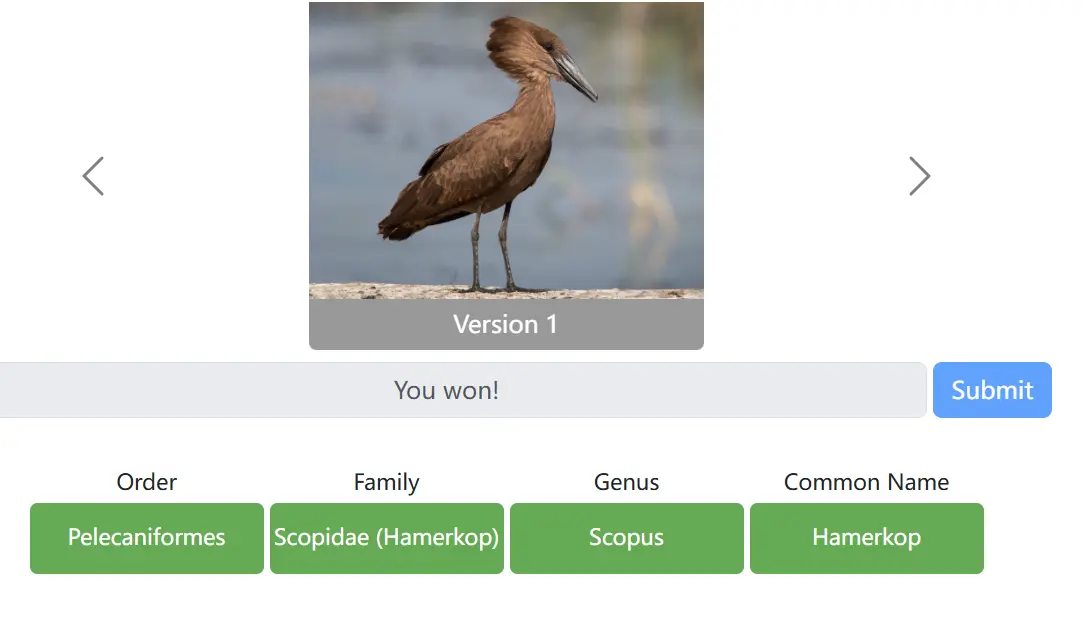
Taxonomy is simply a family tree for living things. In Birdle, it prevents the game from becoming a word-search exercise. Read the clues from broad to precise:
- Order: a large branch of the tree. A match says your bird belongs in the right broad group, but many very different species can still fit.
- Family: a more useful neighbourhood. A family match often tells you which kinds of shape, behavior, habitat, and plumage patterns are worth considering.
- Genus: close relatives. If this matches, slow down and compare the small field marks that separate similar species.
A green taxonomy tile is a direction, not an answer. A family match means 鈥渓ook within this neighbourhood鈥? it does not mean the next familiar bird from that family is automatically right.
A Better First Guess: Build a Useful Baseline
Your first guess should be a bird you can identify confidently, ideally one that represents a broad group you want to test. The goal is not to get lucky. The goal is to learn whether the mystery bird is near that branch of the tree.
After the first result, ask one question: what did this guess rule out? If there is no taxonomic match, move to a genuinely different group rather than another lookalike. If a family or genus matches, stay nearby and use the four views to decide between the remaining relatives.
The Five-Clue Method for Faster Solves
- Silhouette: Start with body proportions. Is it compact or long-bodied? Does it have a hooked bill, a long neck, a crest, long legs, or a distinctive tail?
- Setting: Look past the bird. Water, reedbed, open ground, woodland, garden, and rocky coast all remove candidates quickly.
- Movement and posture: Perching upright, climbing a trunk, wading, hovering, or holding the tail a certain way can be more reliable than colour.
- Markings: Compare one field mark across the four photos: eyebrow, wing bars, bill shape, leg length, face pattern, or tail pattern.
- Taxonomy: Use the order/family/genus result to decide which visual difference matters next.
One photo can make colour misleading, while four views give you a better read on structure, habitat, and markings. You are collecting independent evidence instead of betting everything on one pose.
How to Read Four Bird Photos Without Guessing Blindly
Four photos are useful only if you turn them into specific observations. First describe what repeats across the views: bill length, body shape, a colour block, leg length, or the habitat. Then compare that evidence with the candidates suggested by the taxonomy.
Use a second angle as a tie-breaker when two birds look alike. 鈥淭he family fits, two photos show a short conical bill, and the bird is on open ground鈥?is far more dependable than 鈥渋t looks familiar.鈥?
Turn the Four Angles into a Shortlist
Each photo should change your candidate list. Look for a feature that rules birds out: a pale eyebrow, wing bars, a bill shape, leg length, a face pattern, or the environment behind it.
If you are stuck, use contrast questions: long bill or short bill? tree bird or ground bird? plain underparts or streaked? Those binary decisions naturally lead to more purposeful guesses.
Common Birdle Mistakes
- Chasing colour alone: lighting, age, sex, and a different lighting and poses can all distort colour. Pair it with shape or habitat.
- Ignoring a near taxonomic hit: a family or genus match is usually more informative than one familiar-looking photo.
- Making guesses that test the same thing: if a branch has already failed, try a bird from another meaningful group.
- Using only one photo: confirm a feature in a second view before making your next guess.
- Forgetting the region: Birdle's regional options affect the species pool. Make sure your chosen region matches the birds you expect to encounter.
Birdle as a Tiny Daily Field Guide
The best reason to play Birdle is not a streak. It is building a memory library: how a family tends to look, where its members live, and which field marks separate them. When a bird surprises you, take ten extra seconds after the answer to notice the feature you missed. That small review turns tomorrow's puzzle a little easier鈥攁nd makes your next walk outside more interesting too.
Frequently Asked Questions
What is Birdle?
Birdle is a daily bird identification game. You guess a mystery species and use taxonomic feedback plus four photos from different angles to narrow the answer.
What do order, family, and genus mean in Birdle?
They are levels in biological classification. Order is broad, family is narrower, and genus groups close relatives. Matching a more specific level is a stronger clue.
Is Birdle useful for beginners?
Yes. Start with silhouette and habitat, then let the taxonomy feedback teach you which birds are related. You do not need to know every species on day one.
What should I do after a wrong guess?
Read the taxonomy result first, then compare the four photos to choose a guess that tests a different, specific possibility.
Does Birdle have a new puzzle every day?
Yes. The daily puzzle format gives you a fresh bird to identify each day.